
Services
Software that pays for itself.
Five service lines. They are built to work together, and any one of them can stand on its own if that is all you need.
01 — Our lead offering
Mobile app development
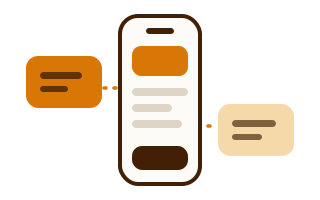
An app is worth building when work happens away from a desk. For most of our clients that means a crew in vans and customers at home, and the app is what keeps those two groups in sync without a phone call.
- Field apps for crews: today's jobs, directions, notes, photos
- Customer apps: booking, arrival windows, history, payment
- Works offline, because job sites have bad signal
- Published to the app stores under your name, not ours
02
Web apps & customer portals
The office half of the same system. Where the mobile app serves the person on site, the web app serves whoever is scheduling, quoting and chasing payment — and a portal lets customers answer their own questions instead of calling to ask.
- Scheduling and dispatch boards that reflect reality
- Quoting, invoicing and job costing in one place
- Reporting that tells you which work is actually profitable
- Customer portals for documents, approvals and history
- Role-based access, so staff see only what they should

03
Websites & e-commerce
A website earns its keep by producing enquiries. That takes fast loading, clear local signals, and an obvious next step on every page. Most sites we replace fail on all three.
- Marketing sites that load in under a second on a phone
- Local SEO groundwork: schema, service areas, page structure
- Online booking, quote requests and deposits
- E-commerce when you sell products as well as time
- Built so your team can edit copy without calling us

04
Automation & integrations
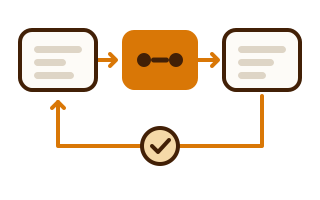
The cheapest software project is usually the one that builds nothing new. Most businesses already pay for four or five tools that do not talk to each other, and someone is being paid to be the glue between them.
- Connect scheduling, accounting, payments and email
- Stop the same job being typed into three systems
- Automatic reminders, confirmations and follow-ups
- AI assistants for triage, summarising and drafting
- Reports that arrive on their own, on a schedule
05
Support & maintenance
Software is not finished when it launches. Platforms change, stores change their rules, and the business itself changes. A retainer means someone is watching, and that the small improvements keep happening.
- A named point of contact and an agreed response time
- Hosting, backups, monitoring and security updates
- App store releases handled for you
- A pool of hours each month for changes and additions
- No lock-in: the code and the accounts are yours

How we charge
Two ways to work with us. Both start with a written number.
We do not publish prices, because the honest answer to "what does an app cost" is that it depends on what it has to do. What we can commit to is that you will know the number before you commit to us.
Fixed-price projects
We scope the work, write down what it includes, and quote one price. If we estimate badly, that is our problem, not an invoice you did not expect.
- One price, agreed up front
- A written scope of what is and is not included
- Staged payments tied to delivery, not to dates
- Changes priced openly before we do them
Monthly retainers
For support, hosting and the steady stream of small improvements that a working system generates. Month to month, cancel with notice.
- A set number of hours each month
- Agreed response times for anything broken
- Releases, updates and monitoring included
- Unused capacity discussed, not quietly billed
The scoping call is free
Half an hour, no charge, no obligation. If it turns out you do not need custom software — and sometimes an off-the-shelf product really is the right answer — we will say so on the call and you will have lost nothing but the half hour.
Tell us what's slowing the business down.
A short call, a written scope, a fixed price. No obligation, and no sales sequence afterwards.